Choosing among wooden door manufacturers in Indonesia requires more than comparing catalog images and unit prices. International buyers should verify whether a supplier operates a real factory, uses legally sourced timber, controls moisture content, follows approved drawings, performs documented quality inspections, and understands export packaging and international shipping.
These factors are especially important for importers, contractors, architects, hotel suppliers, developers, and overseas project owners. A door that looks acceptable before shipment may become difficult to install if its dimensions, moisture level, construction, finishing, labeling, or packaging do not match the project requirements.
A reliable sourcing process therefore starts with technical verification—not price negotiation.
Why International Buyers Source Wooden Doors from Indonesia
Indonesia has a long-established woodworking sector supported by access to hardwood, experienced craftspeople, and factories capable of producing project-specific joinery. It is particularly attractive to buyers looking for teak doors, frames, windows, wall panels, and other architectural wood products.
Access to Solid Hardwood and Teak Production
Teak is widely selected for residential, hospitality, villa, commercial, and institutional projects because of its distinctive grain, visual warmth, and suitability for premium architectural applications.
However, buyers should not assume that every product described as a “teak door” has the same construction. Ask the supplier to confirm:
- Whether the door is made from solid teak, laminated teak, veneered material, or a combination
- The grade and source of the timber
- Whether sapwood is permitted
- The acceptable range of grain and color variation
- Whether the construction is intended for interior or exterior use
These details affect appearance, stability, performance, and cost.
Custom Manufacturing for Project Orders
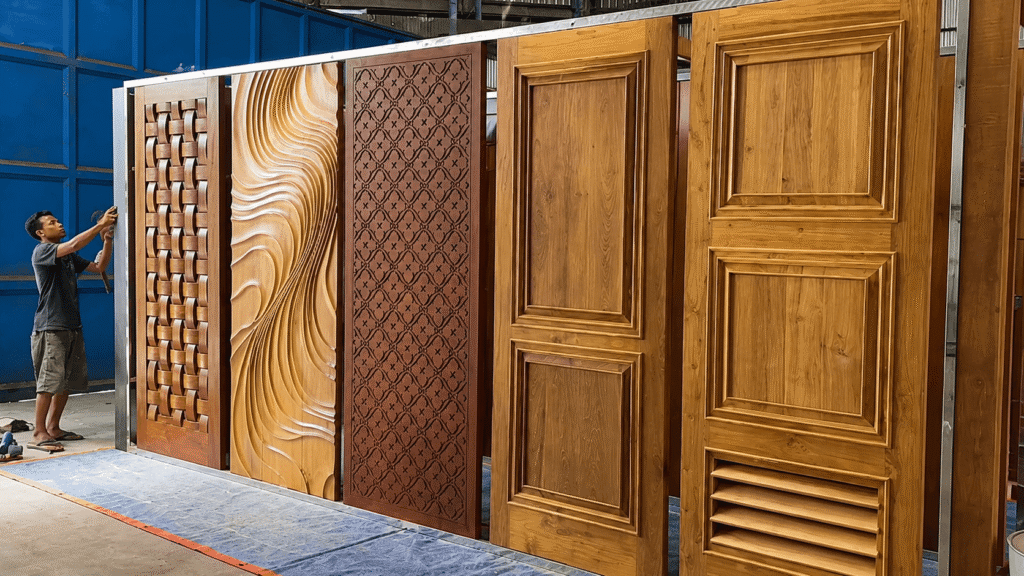
International projects often require more than standard-sized door leaves. The order may include custom frames, architraves, sidelights, transoms, carved panels, glass openings, thresholds, or hardware preparation.
A capable Indonesian factory should be able to manufacture from architectural drawings and convert project information into production-ready shop drawings. This makes Indonesia relevant to buyers who need repeatable designs across villas, hotel rooms, apartments, houses, or commercial buildings.
A Combination of Machinery and Craftsmanship
Consistent door production requires both suitable machinery and experienced workmanship. Machinery supports repeatable dimensions, profiling, sanding, drilling, and routing. Skilled craftspeople remain important for timber selection, joinery, carving, assembly, surface preparation, and finishing.
When evaluating suppliers, look for a process that combines technical control with experienced woodworking—not one that depends entirely on manual judgment.
Manufacturer vs Trading Company
One of the first questions buyers should ask is whether the supplier manufactures the products or purchases them from another workshop.
A trading company is not automatically unsuitable. Some trading companies provide useful sourcing, documentation, and communication services. The risk arises when the buyer believes it is dealing with a direct factory but the supplier has limited control over materials, lead times, workmanship, or corrective action.
What Is a Direct Door Manufacturer?
A direct manufacturer operates or controls the production facility used for the order. It should be able to explain where and how the timber is stored, dried, machined, assembled, finished, inspected, and packed.
A genuine solid door manufacturer should also be able to discuss technical limitations. A supplier that promises every size, construction, design, finishing system, and delivery date without reviewing the specification may not be evaluating the project realistically.
What Is a Reseller or Trading Company?
A reseller typically sources finished or semi-finished products from one or more factories. The company may manage commercial communication while outsourcing manufacturing.
This arrangement can create additional variables:
- The actual factory may change between orders.
- Material selection may not be directly controlled.
- Technical questions may take longer to resolve.
- Quality standards may differ between batches.
- Corrective work may require approval from another company.
- Production updates may not reflect the actual factory schedule.
Buyers comparing solid door manufacturers should therefore verify who will physically produce the order.
How to Verify a Factory
Request a live video tour rather than relying only on edited photographs. Ask the supplier to show:
- The factory exterior and company identification
- Raw-material storage
- Kiln or drying facilities
- Machining and CNC areas
- Assembly stations
- Sanding and finishing areas
- Quality-control procedures
- Completed orders
- Packaging and container-loading areas
For larger orders, consider an in-person factory visit or an independent third-party inspection.
| Evaluation Area | Direct Manufacturer | Reseller or Trading Company |
|---|---|---|
| Factory access | Usually available | May be restricted |
| Production control | Direct | Dependent on another supplier |
| Customization | Usually more flexible | Subject to factory approval |
| Quality correction | Managed at production level | Requires additional coordination |
| Lead-time visibility | More direct | May be less transparent |
| Repeat-order consistency | Easier to control | Depends on the production source |
Important Manufacturing Capabilities
Price should only be compared after the technical scope is aligned. Two quotations may appear to cover the same door while using different timber grades, construction methods, dimensions, finishing systems, hardware preparation, and packaging.
Raw-Material Selection
Ask the factory to define the approved material in writing. The specification should identify:
- Wood species
- Timber grade
- Solid, laminated, or veneered construction
- Sapwood allowance
- Permitted natural characteristics
- Grain and color expectations
- Repair and filling policy
- Interior or exterior application
Buyers researching solid wood doors manufacturers should be particularly careful with the word “solid.” It may describe the visible face, the principal components, or the entire construction. Request a door-section drawing or corner sample to remove ambiguity.
Joinery and Door Construction
Door stability depends on more than the timber species. The manufacturer must select a construction method appropriate for the dimensions, location, hardware, and expected environmental conditions.
Review:
- Stile and rail dimensions
- Panel construction
- Joint type
- Adhesive system
- Door thickness
- Frame section
- Reinforcement for tall or wide doors
- Allowance for hardware and installation
- Exterior exposure requirements
Large pivot doors, double doors, carved doors, glazed doors, and exterior entrance doors may require different engineering from standard interior doors.
Machinery and Process Control
Professional wooden doors manufacturing normally involves several controlled stages rather than a single woodworking process. Relevant equipment may include kilns, planers, thicknessers, moulders, CNC machines, presses, sanding machines, and controlled finishing areas.
The presence of machines alone does not guarantee quality. Ask how the factory calibrates equipment, approves first-off pieces, maintains tooling, and checks dimensions between production stages.
Capacity and Lead Time
Request capacity information that relates to your specific product. A factory’s general monthly output may not represent its capacity for large custom teak doors with complex profiles or specialist finishes.
The production schedule should account for:
- Technical review
- Shop drawings
- Material preparation
- Drying and conditioning
- Sample approval
- Machining and assembly
- Finishing
- Final inspection
- Packaging
- Export preparation
Confirm whether the quoted lead time starts after deposit, drawing approval, material approval, or sample approval.
Finishing and Hardware Preparation
Provide the finishing specification before production. Terms such as “natural,” “dark brown,” or “matte” are open to interpretation.
Use an approved physical sample that defines:
- Color
- Sheen level
- Surface texture
- Grain visibility
- Edge treatment
- Coating system
- Exterior or interior suitability
The hardware schedule should identify hinges, locks, handles, access-control devices, door closers, pivots, bolts, and other components. Precise hardware preparation is especially important when hardware will be purchased in the destination country.
Wood Certification and Legal Documentation
Timber legality should be verified before a deposit is paid. Do not treat a certification logo on a website as sufficient evidence.
Verify the Company’s Legal Identity
The company name should be consistent across its quotation, contract, invoice, bank account, certificates, and export documents.
Request copies of relevant business and manufacturing documents. Check:
- Registered company name
- Registered address
- Factory address
- Business identification
- Industrial authorization
- Tax details where relevant
- Export capability
- Name of the payment beneficiary
A request to pay an unrelated individual or a differently named company should be investigated before funds are transferred.
Request Timber-Legality Documentation
Indonesia uses the SVLK timber-legality assurance framework to verify that timber and timber products originate from legal sources and comply with applicable Indonesian requirements.
Ask the supplier which legality and shipment documents apply to the proposed products. Document requirements may depend on the product classification, destination, shipment structure, and current regulations.
Before ordering, confirm:
- The certificate holder’s name
- The production location covered
- The certificate validity
- The product scope
- The traceability of the timber
- The shipment-specific documents that will be provided
Check Destination-Market Requirements
Legal export from Indonesia does not automatically satisfy every requirement in the destination country. Importers may also need to review customs classification, product standards, due-diligence obligations, labeling, treatment, and documentation.
Involve the importer of record, customs broker, architect, consultant, or freight forwarder before production begins. This reduces the risk of discovering a compliance problem after the doors have been completed.
Kiln-Drying and Moisture Control
Moisture management is one of the most important aspects of solid-wood door production.
Wood absorbs and releases moisture in response to its environment. As moisture changes, the material may shrink, swell, cup, twist, crack, or place stress on joints and coatings.
Why “Kiln-Dried” Is Not Enough
The statement “kiln-dried wood” does not explain:
- The target moisture content
- The tolerance
- The measurement method
- The species correction used
- The sampling frequency
- The depth of measurement
- The storage conditions after drying
- The result at final inspection
A meaningful moisture-control plan should define when readings are taken and how nonconforming pieces are isolated.
Match the Target to the Destination
There is no universal moisture-content target suitable for every project. The appropriate range depends on the destination climate, interior conditioning, exterior exposure, timber species, product thickness, and project specification.
Doors for continuously air-conditioned interiors may require different preparation from products installed in coastal villas, unconditioned buildings, or exposed entrances.
The buyer should provide the location and intended use. The factory should then agree on a measurable target and tolerance before production.
Request Moisture Records
For significant orders, ask for moisture records connected to the production batch. The report should identify:
- Inspection date
- Product or batch reference
- Measurement locations
- Meter type
- Recorded values
- Acceptance criteria
- Inspector
- Corrective action, if required
The doors must also be stored appropriately after kiln drying. Properly dried timber can regain moisture if it is left in an uncontrolled environment.
Custom Door Production
Custom production works best when design decisions are resolved before timber is machined.
Start With Complete Shop Drawings
Drawings should include:
- Door width, height, and thickness
- Frame dimensions
- Wall thickness
- Opening direction
- Panel profiles
- Glass openings
- Architraves and thresholds
- Hardware locations
- Installation clearances
- Finishing references
- Product identification codes
Each revision should be numbered and dated. Production should only begin from the final approved version.
Confirm Size and Construction Limits
Ask the manufacturer to review oversized doors separately. Increased height, width, thickness, or weight can affect stability, hardware selection, frame design, handling, and installation.
A responsible supplier should explain when a design requires reinforcement, an alternative joint, a different panel construction, or specialized hardware.
Approve Samples Before Mass Production
Depending on the order value and complexity, approval may involve:
- Timber sample
- Finishing sample
- Profile sample
- Corner sample
- Hardware mock-up
- Full-size prototype
A sample is useful only when it becomes a controlled reference. Label it, sign it, photograph it, and state whether it is the master standard for mass production.
Set Written Tolerances
Define acceptable tolerances for:
- Width and height
- Thickness
- Squareness
- Straightness
- Hardware positions
- Joint alignment
- Surface defects
- Color and sheen
- Grain matching
- Moisture content
Without written tolerances, the buyer and manufacturer may have different definitions of an acceptable product.
Quality Control for International Orders
Quality control should take place throughout production, not only when the order is ready to ship.
Incoming-Material Inspection
The factory should check wood species, grade, dimensions, visible defects, and moisture before the material enters production.
In-Process Inspection
Inspection points may include machining dimensions, profiles, joint fit, assembly alignment, hardware positions, sanding, and surface preparation.
Early checks are important because correcting an error before finishing is generally easier than repairing a completed door.
Final Inspection
The final report should compare the products with the approved drawings, samples, purchase order, and quality requirements.
Check:
- Product quantity
- Identification code
- Dimensions
- Squareness and straightness
- Moisture readings
- Joint condition
- Surface quality
- Finishing color and sheen
- Hardware preparation
- Frame compatibility
- Packaging readiness
For large, technically demanding, or first-time orders, a pre-shipment inspection can provide additional assurance before the remaining balance is paid.
How to Evaluate a Manufacturer’s Project Portfolio
A portfolio should demonstrate relevant experience, not merely attractive photography.
Ask for projects that resemble your order in terms of:
- Door type
- Timber species
- Dimensions
- Construction
- Finishing
- Quantity
- Building type
- Destination climate
- Export market
Buyers evaluating teak wood doors manufacturers should look for production photographs, packaging records, installation images, and repeat projects. These provide more useful evidence than isolated product renders.
Also ask whether the factory retains approved drawings, color references, and product codes. This is valuable when a hotel, villa, apartment, or housing development later requires replacement doors or an additional phase.
Export Packaging and International Shipping
A well-made door can still arrive damaged if it is packed incorrectly.
Protect the Product Before Packing
The coating must be sufficiently cured before wrapping. Each product should receive suitable surface, edge, and corner protection.
Packaging should prevent:
- Surface abrasion
- Corner impact
- Movement between products
- Pressure marks
- Moisture exposure
- Confusion during unloading
- Loss of matching components
Door leaves, frames, architraves, and accessories should be clearly labeled according to the room, unit, floor, building, or opening reference.
Use Suitable Export Packaging
The required packaging depends on the quantity, product size, shipping method, handling risk, and destination.
Options may include protective wrapping, pallets, crates, or reinforced packages. Where solid-wood pallets, crates, blocks, or dunnage are used, confirm whether the destination requires treatment and marking under ISPM 15.
Reduce Transit-Moisture Risk
Before container loading, check that the products, packaging, and container are dry. Appropriate container moisture-control materials may be considered based on the route, season, transit time, and cargo characteristics.
Do not load products showing wet packaging, active condensation, or unresolved moisture readings.
Clarify Shipping Responsibilities
The quotation should identify the applicable Incoterm and named location. Do not rely only on terms such as “shipping included.”
Confirm responsibility for:
- Inland transport
- Export clearance
- Port handling
- Ocean freight
- Cargo insurance
- Import clearance
- Duties and taxes
- Destination charges
- Final delivery
- Unloading
The commercial invoice, packing list, transport document, legality documentation, and any destination-specific documents should be reviewed before departure.
Questions to Ask Before Placing an Order
Use these questions when comparing wooden doors manufacturers:
- Do you operate the factory that will produce this order?
- Can you provide a live factory tour?
- What timber species, grade, and construction are included?
- Which timber-legality documents can you provide?
- What moisture target and tolerance will be used?
- How will moisture readings be recorded?
- Can you produce from our architectural drawings?
- What dimensional tolerances can you guarantee?
- Can you provide samples before mass production?
- What is the realistic production schedule?
- Which quality-control reports will be supplied?
- Can we arrange an independent inspection?
- How will every door and frame be identified?
- What export packaging will be used?
- Which Incoterms can you quote?
- How are defects, replacements, and warranty claims handled?
A supplier’s ability to answer these questions clearly is often more valuable than a small difference in unit price.
Warning Signs When Evaluating a Supplier
Proceed carefully when a supplier:
- Refuses to show its production facility
- Cannot identify the actual factory
- Gives unclear answers about timber origin
- Uses “kiln dried” without measurable criteria
- Quotes before reviewing the drawings
- Offers unusually low pricing without a complete specification
- Does not use sample approval
- Cannot define production tolerances
- Provides no inspection records
- Changes company or bank-account details unexpectedly
- Has no written packaging plan
- Cannot explain its claims procedure
One red flag may have a reasonable explanation. Several combined red flags indicate a higher procurement risk.
Work With Safira Jati, a Custom Solid Teak Door Manufacturer in Indonesia
Selecting the right supplier is easier when buyers can work directly with a factory that understands custom production, solid teak construction, quality control, and international project requirements.
Safira Jati is an Indonesian manufacturer specializing in custom solid teak doors, door frames, windows, and related architectural wood products. Its direct factory production model gives international buyers a clearer line of communication throughout material selection, drawing approval, manufacturing, finishing, inspection, packaging, and shipment preparation.
Custom Solid Teak Doors for Project Requirements
Safira Jati produces solid teak doors based on the requirements of individual projects rather than limiting buyers to standard catalog sizes.
Custom production can accommodate project-specific requirements such as:
- Door width, height, and thickness
- Single, double, sliding, or pivot-door configurations
- Custom panel profiles and carved details
- Matching teak frames and architraves
- Glass openings and decorative elements
- Hardware preparation
- Interior or exterior applications
- Natural, stained, painted, or project-specific finishes
This flexibility is particularly relevant for architects, contractors, developers, hotel suppliers, importers, distributors, and project owners who need doors manufactured according to architectural drawings or door schedules.
Buyers can submit drawings, reference images, dimensions, hardware details, and finishing requirements for technical evaluation before production begins.
Direct Factory Production
Safira Jati operates as a direct manufacturer rather than simply presenting products sourced from unrelated workshops.
Direct factory production allows the company to coordinate important manufacturing stages, including:
- Timber preparation
- Wood drying
- Material selection
- Machining and profiling
- Door assembly
- Custom detailing
- Sanding and finishing
- Dimensional inspection
- Product labeling
- Export packaging
For international buyers, working with the production factory can provide greater transparency when discussing construction methods, production schedules, technical revisions, inspections, and corrective action.
The factory capabilities presented by Safira Jati also include production equipment and dedicated areas for wood processing, drying, CNC work, assembly, and finishing.
Solid Kiln-Dried Indonesian Teak
Solid wood doors must be manufactured from properly prepared timber. Moisture that is not sufficiently controlled can contribute to movement, cracking, twisting, joint problems, and installation difficulties after delivery.
Safira Jati states that its solid teak doors are manufactured using properly dried Indonesian teak. Kiln drying is intended to reduce and control moisture before the timber proceeds through machining and assembly.
For project orders, buyers should still agree on measurable moisture requirements, including:
- Target moisture-content range
- Permitted tolerance
- Inspection method
- Sampling frequency
- Measurement stage
- Destination climate
- Interior or exterior installation conditions
This approach helps ensure that the drying specification is aligned with the actual environment in which the doors will be installed.
Certified and Legally Sourced Timber
Timber legality and traceability are essential considerations for international procurement.
Safira Jati presents itself as a licensed and certified Indonesian wood manufacturer using teak from government-regulated and responsibly managed sources. Its website displays Indonesian Legal Wood, FSC, and TKDN references as part of its company credentials.
Before placing an order, international buyers may request current copies of the documents relevant to their products and shipment. The review should confirm:
- The legal company name
- Certificate holder
- Certificate number
- Current validity
- Covered production facility
- Product scope
- Timber traceability
- Export-document requirements
- Requirements of the destination country
This verification process allows importers to confirm that the documentation is current and suitable for the specific products being purchased.
Experience Serving International Markets
Safira Jati has supplied teak products to buyers in multiple international markets. Shipment destinations presented by the company include countries in Europe, Asia, North America, and the Asia-Pacific region.
The countries listed by Safira Jati include:
- The Netherlands
- The United Kingdom
- Japan
- The United States
- Australia
- Switzerland
- India
- France
- Germany
- Austria
- Latvia
- The Maldives
Experience with international shipments is important because export orders require more than manufacturing knowledge. The supplier must also understand product coding, protective packaging, container preparation, export documentation, and coordination with freight-forwarding partners.
Buyers should discuss the destination, shipping method, Incoterm, packaging specification, and required documents during the quotation stage.
Production for Residential, Hospitality, and Commercial Projects
Safira Jati’s custom solid teak doors can be evaluated for a range of applications, including:
- Private residences
- Luxury villas
- Hotels and resorts
- Apartments
- Offices
- Commercial buildings
- Religious buildings
- Cultural properties
- Property-development projects
- Distributor and importer inventories
Project suitability should be confirmed according to the intended application, dimensions, environmental exposure, hardware, construction method, and applicable destination-market requirements.
Custom Drawings and Sample Approval
International buyers can reduce production risk by providing complete project information before requesting a final quotation.
A technical enquiry should preferably include:
- Door schedule
- Architectural drawings
- Opening dimensions
- Door and frame sections
- Quantities
- Timber specification
- Design references
- Finishing requirements
- Hardware schedule
- Interior or exterior application
- Destination country
- Required delivery date
For custom orders, buyers may also request a material sample, finishing sample, corner sample, or full-size prototype before mass production.
The approved sample and final shop drawings should become the reference for manufacturing and quality inspection.
Quality Control and Export Preparation
International door orders should be inspected at several stages rather than only after production has been completed.
Depending on the agreed scope, inspection may cover:
- Timber species and quality
- Moisture content
- Door dimensions
- Frame dimensions
- Joint construction
- Squareness and straightness
- Panel and profile details
- Hardware preparation
- Surface preparation
- Finishing color and sheen
- Product identification
- Packaging condition
Buyers may also arrange an independent pre-shipment inspection for high-volume, first-time, or technically complex orders.
For shipment preparation, each door, frame, and related component should be protected and clearly identified. Packaging can be planned according to the product dimensions, quantity, shipping route, container method, and handling risk.
Why International Buyers Can Consider Safira Jati
Safira Jati combines several capabilities international buyers commonly look for when evaluating teak door manufacturers:
- Direct factory production in Indonesia
- Custom solid teak door manufacturing
- Custom sizes and architectural designs
- Matching teak frames and windows
- Properly dried timber
- Certified and traceable wood positioning
- Factory-based quality control
- Export packaging support
- Experience shipping to multiple countries
- Production for residential and commercial projects
The final specification, documentation, tolerances, inspection process, packaging method, and shipping responsibilities should be agreed in writing before an order is confirmed.
Request a Custom Teak Door Quotation
For the most accurate assessment, send Safira Jati your drawings, door schedule, quantities, dimensions, finishing requirements, destination country, and expected delivery date.
Explore Safira Jati’s custom solid teak door manufacturing in Indonesia and discuss the requirements of your international project.
You can check here https://en.safirajati.id/
How do I verify a wooden door manufacturer in Indonesia?
Request company documents, a live factory tour, timber-legality information, production records, samples, moisture reports, and comparable project references. For larger orders, arrange a factory visit or independent inspection.
What is the difference between a manufacturer and a trading company?
A manufacturer directly controls production. A trading company sources products from another factory. Both models can work, but buyers should know who controls timber selection, manufacturing, quality correction, and delivery.
Can Indonesian manufacturers produce custom-sized doors?
Yes, many factories can produce custom sizes, frames, profiles, carvings, finishes, and hardware preparation. The supplier must review the design, construction limits, tolerances, and intended application before confirming feasibility.
What moisture content should a solid wood door have?
There is no single target for every door. The range should be agreed according to the timber species, destination climate, indoor conditioning, exterior exposure, product thickness, and project requirements.
What legal timber documents should a supplier provide?
Ask for valid company and timber-legality documents relevant to the manufacturer, product, and shipment. Buyers should also confirm destination-country requirements with their importer or customs adviser.
Should I order a sample before mass production?
Yes, particularly for custom profiles, special finishes, large dimensions, or high-volume orders. The approved sample should become the documented reference for production and inspection.
How are wooden doors packed for international shipping?
Export packaging may include surface wrapping, edge and corner protection, separators, pallets, or crates. Each item should be coded, secured against movement, and protected from handling and moisture risks.
How long does a custom order take?
Lead time depends on drawing approval, timber preparation, drying, sampling, production complexity, finishing, inspection, packaging, and order quantity. Ask the factory to provide a stage-by-stage schedule.
Can I arrange a third-party inspection?
Yes. Independent inspections can be conducted before production, during manufacturing, before shipment, or during container loading. They are particularly useful for first orders and large projects.
What should I send when requesting a quotation?
Send the door schedule, drawings, quantities, sizes, construction details, finishing reference, hardware requirements, destination, packaging expectations, and desired delivery date.